
Subtitle: How I spent my summer vacation on a six-week internship with photographer Art Sinsabaugh.
[Excerpts from my 5000 word paper…]
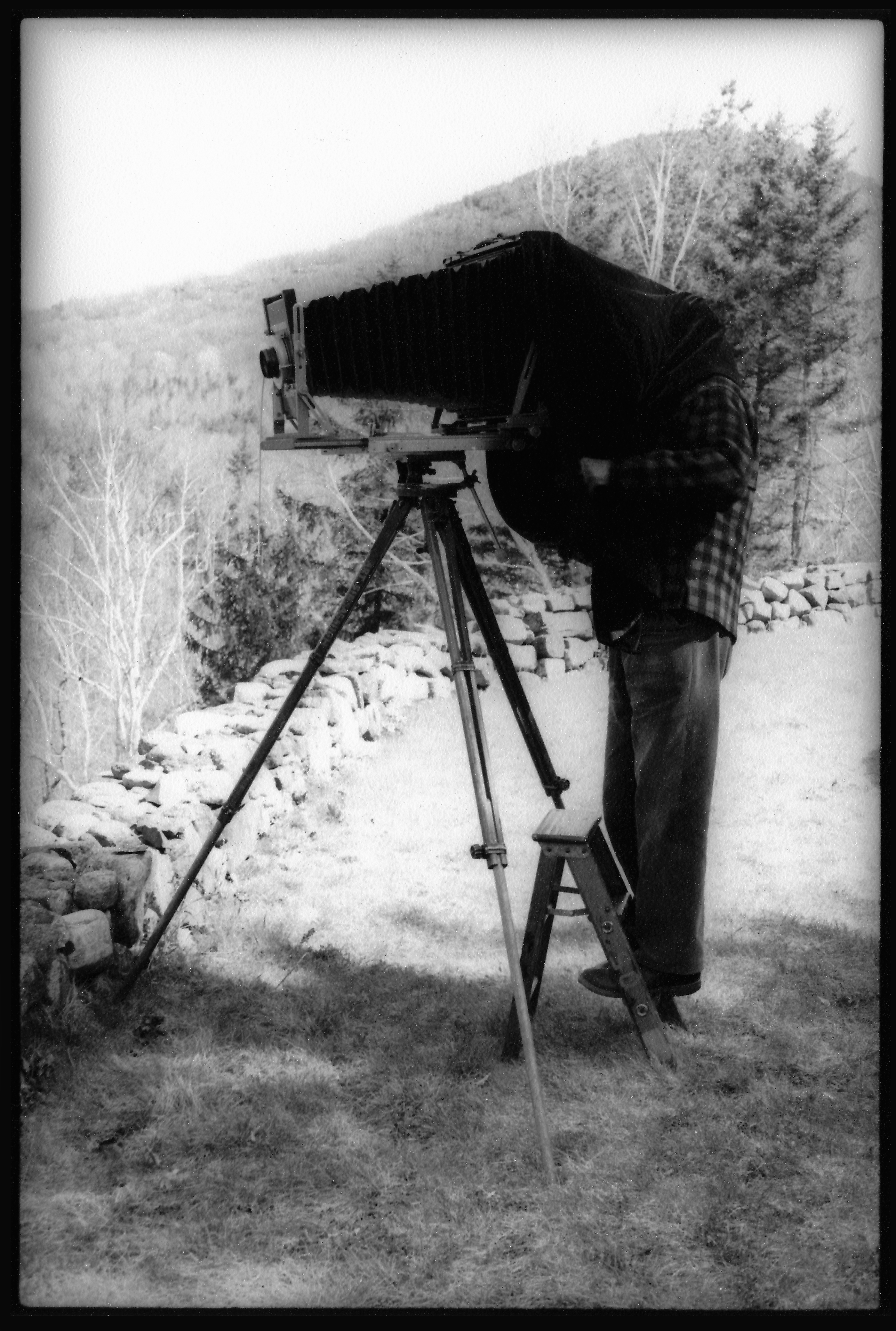
I assisted the noted photographer, Art Sinsabaugh, during the summer of 1983, as he travelled through the Adirondack Mountains in upstate New York with his 12″ x 20″ Deardorff view camera. As a communications major with a minor in art/photography, I was thrilled to have the opportunity, though I did not (yet) know anything about Art Sinsabaugh or his work.
The Lake Placid Center for Music, Drama & Art (CMDA) had offered a small grant to Art as part of their Nettie Marie Jones Visual Arts Fellowship program. He was one of five artists chosen, each working in a different medium: ceramic sculpture, fibers, landscape painting, print-making, and photography. Because of the size and weight of the camera he used, Art would need an assistant, so the CMDA put the word out. I jumped at the chance.
Art Sinsabaugh was an extraordinary man. He had studied and worked with many of the most celebrated photographers in the world; Aaron Siskind, Maholy-Nagy, and Harry Callahan among them. He had received numerous awards, grants and commissions, including a Guggenheim Fellowship. His work is in the permanent collections of the Museum of Modern Art in New York, the Chicago Art Institute, the George Eastman House, the Smithsonian Institution, the Victoria and Albert Museum in London, and others. He had been published many times and was a founding member of the Society for Photographic Education. In New York City, he was represented by the Daniel Wolf Gallery.
When we arrived in Lake Placid, Art was waiting in the building that housed the darkroom, where he had spread out all his work materials on the floor and countertops. He promptly introduced me to his Deardorff camera, and all of its parts. Working with at least three bubble levels, and a number of carefully calculated markings, Art had devised a remarkably precise method by which to set it up. After a brief lesson, I proceeded to assemble the camera, lens and tripod, fifteen to twenty times, as quickly as I could. My first attempts were less than satisfactory, due to the overwhelming quantity of new information I had to sort through, in addition to being quite nervous. Art stood behind me, barking commands and corrections, until, after almost three hours, I could complete the camera set-up with some small degree of precision. Most importantly, he had impressed upon me an awareness of Dust Particles, the archenemy of photographers.
Our first exposure was taken shortly after noon on the following day. We spent the morning travelling some of the more well-known routes, with Art driving and me taking copious notes on potential sites we had passed. He also had me write down the type of weather conditions for which he would like to return to each site. We ended up on a mountain road above the town of Keene. I observed him as he smoothly and easily convinced a lone housewife to allow us — two rough-looking men in an ominous pick-up truck — to photograph the splendid view of the High Peaks from her back porch. This was my first day in active duty, and of course I had forgotten everything. Luckily, Art did not seem to mind.
He had to set up almost everything himself, this first time, while explaining it all to me once more. This time I remembered every word. He also urged me to take pictures myself, using my 35mm camera, as long as it did not interfere with my duties. I acquiesced, humbly. He felt it was a sin for anyone who owned a small, portable camera to not “make” photographs constantly. He chose the word “make” (like Ansel Adams) and I found it enlightening to hear it said that way.
Art wished to limit his efforts to composing, focusing, and snapping the shutter at the moment of truth. So, after unloading the truck and transporting everything to the exposure site, it was necessary for me to set up and level the tripod, set up and level the camera, and to make all the major camera adjustments. He would then take a light meter reading and tweak the camera settings.
I would finish my part by bringing him the loaded film holders, stopping down the lens, cocking the shutter, and holding the gel in place, while Art waited for the perfect light and made the exposure. (He used the standard red and yellow gels to improve contrast on his black & white film and to make clouds stand out.) In the rapidly changing weather of the mountains, Art would often take three or more exposures over a half-hour, of the same scene, but under vastly different lighting conditions. At our first site, high above Keene, on this chilly day in May, he only made two.
Art would take a black & white Polaroid to simulate each exposure, both to test it, and for record keeping. Each evening, when we returned to Lake Placid, he would glue these Polaroids into a log book that we both maintained, along with all location and exposure information. All the notes I had taken during the day would be condensed and included in this log book. I was also tasked with keeping track of all the sites we had visited, which was accomplished by highlighter pen markings and scrawled notes, all over a map of New York State.
The enormous 12″ x 20″ size of his negatives required an agile, experienced hand to load them, and our six-week sojourn was not long enough for him to waste time training me, so he did it himself. Also, with the cost of his custom-made Kodak film being so high, he did not wish to risk having me damage even a single sheet. I welcomed the brief respite provided by his loading days.
One day, Art allowed me to expose a single negative. He had been promising it for a week, but my chance came as we were shooting the view of Giant Mountain, as seen looking east from the grounds of the Saint Hubert’s Golf Club. Art’s only requirement was that I shoot something I really liked. Since I would be far too embarrassed to shoot a landscape in his presence, I chose to shoot the main building of the Golf Club behind us, with its intricate details and remarkable symmetry.
Art approved, so I hauled his gear over to a central spot and attempted to set it up. Suddenly, his camera became the most complex thing in the universe; I could not, for the life of me, adjust it properly. He thought it hysterically funny. I found it humbling. In my own defense, deciphering the view camera’s inverted (upside-down) image on glass, viewed under the black cloth, takes years of experience just to capture a decent photograph. Art, of course, was creating fine art with the same gear. Finally, with his copious assistance, I managed to get the perspective correct, and all the lines of the building straight. I waited (as he always did) for the light to soften, and then snapped the shutter-release. I was delighted. The experience gave me new excitement about our work, and a tremendous amount of new respect for Art.
For the adventure, Art devised a system of waterproof transportation especially for the boat we would use. It involved elaborate (of course) tie-downs, protective wrappings, and a trio of overlapping tarpaulins. Part of the reason we did not make many exposures there was because of the often-threatening weather we had, on top of the difficulty involved with unpacking and repacking the camera in this situation.

After Art was gone, an emptiness overwhelmed me. I had been so busy working and living with him, every day for six weeks, that I never realized how much I admired him and how attached to him I had become. I felt very lucky to have been able to share that time with him.
Art died in October of 1983, only four months later.
[The rest of this paper may be retrospectively published as a book with narrative photos some day, even though it’s almost 40 years later. If it happens, I’ll post about it here…]
 russ murray
Leave a comment